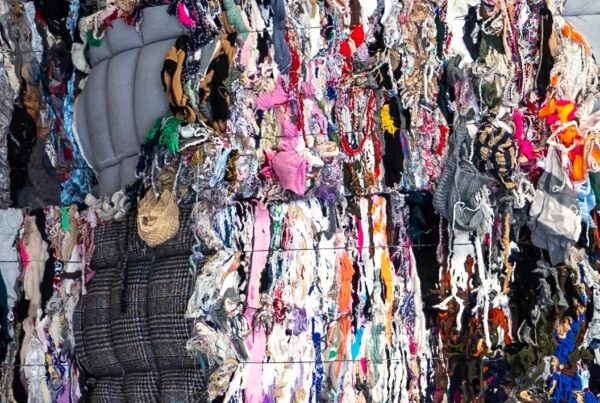
It is a warm and sunny day in Faisalabad, Pakistan, although the region’s notorious annual smog dims much of the sunlight. The thick layer of greyish dust surrounding the textile recycling units does little to brighten the area. Today, we visit an area where industrial textile waste – also called pre-consumer waste – as well as imported used clothing are processed.
When we enter one of the recycling units, we see piles of pre-consumer textile waste waiting to be processed. Pre-consumer textile waste is the leftover material generated at various stages of garment and textile production, such as in garment factories and spinning mills. Worldwide, the fast fashion industry generates a massive amount of textile waste. In an attempt to transform the highly polluting industry into a more sustainable one, fast fashion brands are striving to incorporate ever more recycled content into their textile items.
While using recycled materials in new jeans or dresses may seem like a positive step, much of the textile recycling industry falls short of true sustainability and does not guarantee that a garment made with recycled content is a responsible purchase. In Faisalabad’s textile recycling hub for instance, most of the textile workers work under informal arrangements, without access to essential social security schemes such as health insurance or pensions. They experience harsh and unhealthy working conditions. In the recycling unit we visit, men and women work in dust-filled facilities without any protective gear, inhaling cotton particles day after day. Workers also handle bleaching chemicals with no protection whatsoever.
The end-product of the unit we visit is shredded fibres, that still need to be spun into yarn. Part of it is sent to a large export factory, that has well-known fast fashion brands as clients.
Many fast fashion brands promote products made with recycled materials as part of their sustainability strategy. Yet, how many have actually visited a recycling unit like the one we are in, witnessed the harsh reality of the industry, and taken real action to turn the exploitative work of those producing recycled content into fair and dignified employment.
When we leave the unit, the workday has come to an end. We see workers from the various recycling units in the area heading home. By bus, by autorickshaw, by foot. A woman, seemingly well past the retirement age now walks by. We had seen her already earlier that day, working in one of the units. Who knows how long she has been doing this work or for how long she will have to continue, since she likely has no pension to fall back on.
Arisa’s fight to recognise the rights of textile recycling workers in South Asia started eight years ago in Panipat, a major textile recycling hub in India. Since then, together with partner organisations in South Asia, we have been advocating for awareness of these workers’ conditions and stressing the inclusion of social issues in recycling and circularity initiatives. Amid the growing focus on sustainability and a just transition in the fashion industry, we will continue to share workers’ stories and realities, aiming to improve conditions in this part of the sector. Although it sometimes feels like a long haul, thinking about the old lady that we observed keeps us motivated. If she needs to keep it up, we need to keep it up as well, hoping that one day she, or at least the next generation, can finally enjoy the well-deserved right to retire.